
2026-05-09
English Articles
Japan’s Microgreens Market
Japan’s Microgreens Market
A Local History with Global Lessons
Editor’s Note: This article revisits and rewrites an article originally published on December 16, 2020.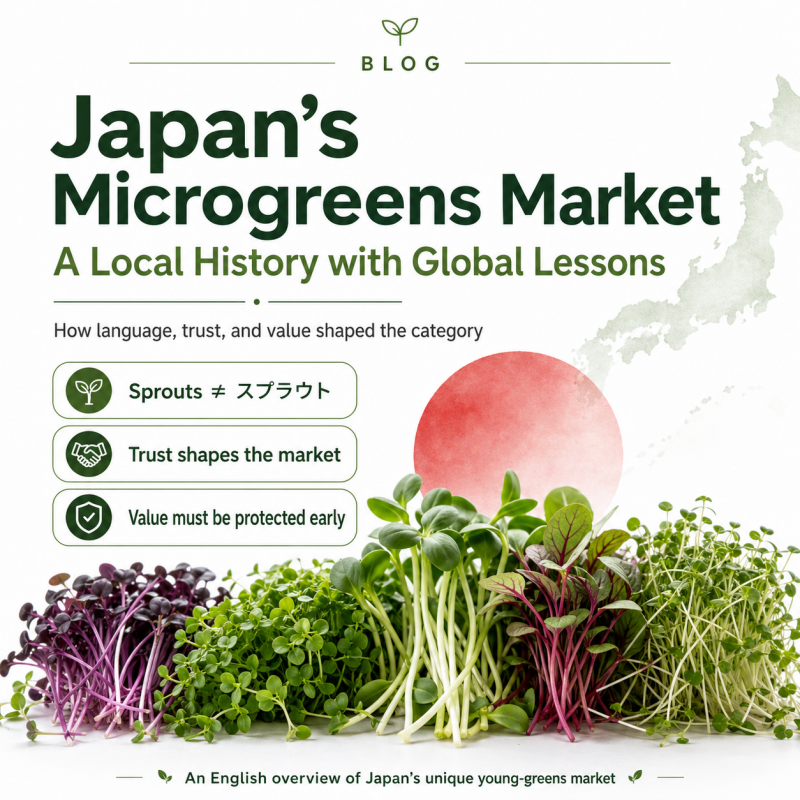
If international readers want to understand Japan’s microgreens market, the first thing to know is this: Japan did not begin with “microgreens” as the world now commonly understands the term. Japan first built a domestic market for young greens, especially kaiware daikon—young radish shoots—which became one of the country’s best-known products in this space.
That difference matters.
Japan’s story is not simply the story of a country “catching up” to a global trend. It is the story of a market that already had a long history with young vegetable products, but not always under globally aligned terms, structures, or value logic. That makes Japan especially useful to international readers. It shows how a food category can become commercially visible before its meaning is fully stabilized—and how difficult it can be to rebuild that meaning later.
Before “Microgreens,” Japan Already Had a Market for Young Greens
Young greens were not new to Japan in cultural terms. What changed in the modern era was not their existence, but their industrialization.As hydroponic methods, mechanized production systems, and larger-scale cultivation expanded in the late twentieth century, kaiware daikon moved from being a limited item into a mass-market product. Young greens became something that could be standardized, distributed, and produced at commercial speed.
At first glance, this looks like a success story. In one sense, it was. Japan demonstrated very early that a young-plant vegetable category could be produced efficiently and sold widely.
But that success also exposed a deeper vulnerability:
A category can grow commercially before its value is fully protected.
Once a category expands quickly, the market often simplifies it just as quickly. Instead of asking what the product uniquely means, the market starts asking how efficiently it can be produced, priced, and moved.
That shift is one of the central lessons of the Japanese experience.
Why “Sprouts” and the Japanese Word Supurauto Drifted Apart
One of the most important things for English-speaking readers to understand is that the English word “sprouts” and the Japanese katakana word 「スプラウト」 (supurauto) do not always mean the same thing in practice.In English, sprouts usually refers to very young germinated seeds—such as alfalfa sprouts or mung bean sprouts—grown in darkness or low light and harvested at a very early stage. The emphasis is on germination and the first phase of growth.
In Japan, however, the word スプラウト gradually developed in a broader and somewhat different way. It came to include not only true sprouts in the English sense, but also products that, in international usage, may be closer to microgreens or other young vegetable categories.
Why did this happen?
It was not just a translation issue. It happened because Japan did not simply borrow a word. It built a market first.
Products such as kaiware daikon, broccoli sprouts, and tōmyō were already being produced, sold, and recognized in Japanese food culture under a broad category of young vegetables. The borrowed English-derived word supurauto became attached to that domestic market. In other words, Japan did not simply import the meaning of “sprouts.” It absorbed the word into an already emerging commercial and cultural framework.
This is not a small linguistic detail. It is a structural market issue.
What appears to be the same word may actually point to a very different category history, a different retail tradition, and a different consumer understanding. This is why direct translation can be misleading: what looks like a shared word may conceal a different market structure underneath.
That is one reason Japan matters so much. It shows how language itself can influence category value, positioning, and consumer understanding long before the category is fully mature.
The O157 Crisis and Why Trust Became Part of the Market
Japan’s young-greens market was shaped not only by growth and efficiency, but also by crisis.One of the most severe turning points came with the 1996 O157 food-poisoning incident in Sakai, Osaka. Kaiware daikon was publicly linked to the incident, and even though the accusation was later overturned, the reputational damage to the category was enormous.
For international readers, the most important lesson is not the legal detail. It is the structural consequence:
A young, freshness-based category can lose trust much faster than it can rebuild it.
After that shock, the market did not simply continue as before. It had to rebuild under pressure from hygiene, sanitation, and accountability. Safety systems, production management, and trust became inseparable from the category itself.
This matters because global conversations about microgreens still often focus on nutrition, freshness, chef appeal, urban farming, home growing, and visual beauty.
Japan adds another essential layer:
Trust is not a side issue in young-plant markets. It is part of the category itself.
If a category is sold through ideas like vitality, cleanliness, freshness, and health, then any hygiene crisis becomes more than a safety problem. It becomes a crisis of meaning.
This is one of Japan’s major lessons to the world. Categories like this are not protected by branding alone. They are protected by credible systems.
Why Japan Produced So Much, Yet Still Struggled to Build Category Value
One of the most revealing parts of Japan’s experience is that production success did not automatically become value success.Japan developed systems capable of producing young greens reliably and efficiently. But the deeper problem was whether those products could be priced, explained, and differentiated properly.
When value is defined mainly by supermarkets, wholesale markets, and intermediaries, categories are often pushed toward low prices and narrow meanings. That appears to have been one of the structural difficulties in Japan.
The market became good at producing a few major products in stable volume. But it became less capable of sustaining richer differentiation, deeper explanation, and broader diversity in smaller-volume categories.
This is where the Japanese story becomes globally important.
The real question is not simply whether a market can grow young greens. The real question is whether it can reward:
・differentiated use
・culinary role
・visual value
・freshness with meaning
・roduct diversity
・a stronger story than low price
If it cannot, price competition returns before the category’s value has fully matured.
That is one of the clearest warnings Japan offers the rest of the world:
Young-greens categories can become operationally efficient long before they become economically or culturally mature.
This is not only a Japanese problem. It is a category-design problem.
Why Japan Matters to the Global Future of Microgreens
Japan matters to the global microgreens conversation not because it has already solved the category, but because it has already lived through many of the problems other markets may still underestimate.It has seen:
・rapid expansion in a young-greens category
・intense price competition
・collapse of public trust
・long sanitation-driven recovery
・category confusion built into language
・and a market that could produce efficiently without necessarily securing deeper value
That is why Japan deserves international attention.
Not because it is the biggest microgreens market. Not because it invented the category. But because it offers one of the clearest case studies of what can go wrong when a young-plant market becomes commercially active before it becomes conceptually stable.
Japan is not a blank market waiting to receive microgreens. It is a country with a long history of young greens—yet not always under globally aligned terms or structures. That makes it a particularly revealing test case.
If Japan remains trapped in an older logic—young greens as familiar, low-priced, health-oriented vegetables—then it may struggle to build a distinct microgreens category at all.
But if Japan can move beyond that, it may contribute something globally valuable: a more careful model of how to define, protect, and grow a category before it gets flattened too early.
In that sense, Japan is not only part of the microgreens story.
It may be one of the clearest places to see what this category must avoid—and what it could still become.
The Larger Lesson
Japan’s microgreens market is not merely a local story about radish shoots, one trade association, or one company’s long-term observations. It is a structural story about how categories form—and how they lose shape.It reminds the world that categories like microgreens are shaped by much more than seeds, trays, or nutritional claims. They are shaped by:
・language
・trust
・retail logic
・consumer explanation
・production structure
・and the ability to hold value together before the market simplifies everything too early
That is why international readers should pay attention.
Japan may not be the final answer to the future of microgreens. But it is one of the clearest places to see the risks, the distortions, and the unfinished possibilities of the category itself.
And sometimes, seeing the danger clearly is the first step toward building something better.